Fast Broadband in Denmark
In Denmark the number of broadband connections providing an Internet service of at least 30 Mbps had risen by 78 percent in the first half of 2013, compared with the same period a year earlier, and reaching 480,000. Broadband service at this speed now account for a little over 21 percent of all broadband subscriptions sold, up from 12 percent a year earlier, according to the Danish Business Authority. Slightly more than 1 percent of homes and business have broadband service at 100 Mbps.
Fixed broadband penetration in Denmark is now over 40 percent. From the middle of 2012 until the middle of 2013, the number of fixed broadband connections went up by 3.8 percent. There were 50,000 new fiber subscriptions and 43,000 new Internet subscriptions via cable TV networks. Mobile Internet traffic grew by 127 percent over the same period, reaching an average of 3.3 GB.
For further reading, see the Denmark Broadband Market Insights, Statistics and Forecasts Report, this report provides a comprehensive overview of the latest developments and statistics in Denmark’s fixed and wireless broadband markets, including the subscriber forecasts to year 2020.
SEO Help from Internet World Stats
Internet World Stats has updated its SEO page, check it out. A recommended new addition to see there is a short video from Matt Cutts with great tips for SEO.
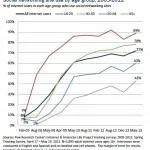
Age Factor and Social Web Growth in the United States
This is very interesting research from PEW about social networking:
Croatia in the European Union Stats
As of July 1st, 2013 Croatia became a member state of the European Union. Now the symbol must be EU28. We have updated the European Union page and included a new metric for broadband speed in each country.
Internet Users in 2020
 Only seven years from now it will be 2020, a very intertesting year because it will be the end of the twenty-tens and the start of the twenty-twenties. The big question is how many people will be online at that time?
Eric Schmidt has boldly predicted that everyone in the world will be online by 2020. This has already caused an uproar of neysayers. I agree with Eric Schmidt, in part. He should have added the word nearly, making the frase: nearly everyone will be online in 2020. But maybe Eric Schmidt is right because he is better informed and has reasons we ignore, to back-up his bold statement.
Internet users are growing in Africa and Latin America at a fast pace with support from the local governments. Already in Colombia Internet Penetration in the larger cities (with over 200,000 population) has reached 80%. Internet World Stats data shows 34.3% penetration worldwide for mid-year 2012. For mid-year 2020, we predict Internet world penetration will be in the range of 75-85%. For the majority of developed countries, our forecast is a 90% Internet user penetration rate.
Iran Internet Users
IRNA has informed that more than 45 million people are using Internet in Iran as of March 2013. This shows a healthy increase since our last report for IRAN.
The number of GPRS users amounts to 27.5 million, accounting for 36 percent of total Internet users in Iran. Some 867,000 people are using high-speed Internet, and about 6 million people are using Internet via optical fiber network.
Iran has been developing the “national Internet” since 2005 to improve control over its content as well as its speed. The project, which is separate from the World Wide Web, is scheduled to be completed by 2013. This network will be separated from the rest of the world Internet and is specifically for domestic use.
.
SEO Help for Ranking New Websites
SEO Help for Ranking New Websites is a video from Google webmaster tools that contains valueble tips and advice that will clarify the does and don’t for successful websites.
Good SEO should be included into all website designs. Good content plus good search engine optimization are the key ingredients for success with your website.
Every website owner should know about the correct way to do SEO, whether you build the site yourself or have a web designer build it for you. Therefore look at this short video, it can represent the best cost benefit return to ten minutes of your time.
The New Literacy in the Internet Era
I take the Internet for granted and consider it as just another form of media, like the radio, the TV, the Press and so forth. It is really amusing to read the thousands of articles where clueless writers try to explain in words what the Internet is all about, to all of us, to you and to me. They also write about the digital divide and it’s perils. Some writers go further and point out that in geographic areas where access to the Internet has become more universal, a new type of digital divide is forming (they call it a second-level digital divide) and label it as a ‘digital inequality’. They forget that we are all living in a technological revolution.
In the beginning of times (by this, I mean before the Internet in 1994), literacy skills were simply reading and writing. Things have changed, and today as I see it, any person (child or adult) to be rightly considered educated and literate should know how to write and read as well as how to use a computer and access the web.
Of course people are free to use the Internet or not to use it, to accept and use new technology or not, and that should be the way to go. I consider this the: “digital choice“. It is the right of choosing that we all have in free countries. The truth of this issue is that, with very few exceptions, every year more and more people become new Internet Users in every country. These millions of persons have made their “digital choice“, which is of course the right choice.
The Internet is simply a consequence of the technological revolution that started in the middle of the last century. Previously we had the industrial revolution. And before that, we had the social revolution, when people populated and formed the urban areas. Today we live in the technological revolution, where technology is changing everything. Here is a three minute video that tries to explain how the Internet has changed our lives: Technology is Now.
The Power Behind Google
The real power behind Google is its world-wide physical network, its thousands of fiber miles, and the many thousands of servers that, in aggregate, add up to the mother of all clouds. This multibillion-dollar infrastructure allows Google to index over 20 billion web pages a day, to process more than 3 billion daily search queries, to conduct millions of ad auctions in real time, to offer free email storage to 425 million Gmail users, to zip millions of YouTube videos to users every day, and to deliver search results before the user has even finished typing the query.
The following video shows the tip of the iceberg of Google’s amazing infrastructure:
Internet usage In Malta
According to the National Statistics Office of Malta, during 2012, an estimated 78 per cent of the households had access to a computer at home. Nearly all households who had a computer at home also had access to the Internet. Overall, the share of households with children having access to a computer and to the Internet was higher than that for households without children.
The number of Internet users who made use of e-Government services during 2012 increased by 9.5 per cent over the previous year, to 128,507. The use of e-Government was most popular among persons between 35 and 44 (66 per cent) and was closely followed by those in the 25 to 34 age bracket (64 per cent). Results also show that the use of e-Government is most common among persons holding a tertiary level of education (83 per cent). This category also registered a marked increase of 6 percentage points when compared to 2011 levels. Read more.